
What is Woodturning
Adapted from articles by Kay Liggett and Betty J. Scarpino
In woodturning, you use a wood lathe with hand-held tools to cut a shape that is symmetrical around an axis. Like the potter’s wheel, the wood lathe is a simple machine that lets you create a variety of forms limited only by your imagination.
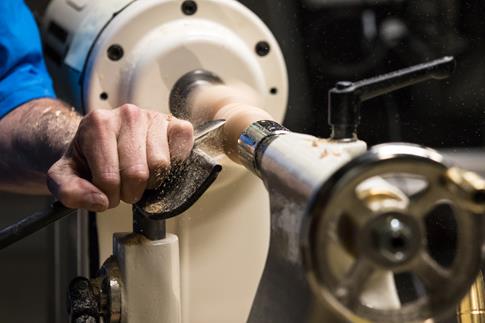
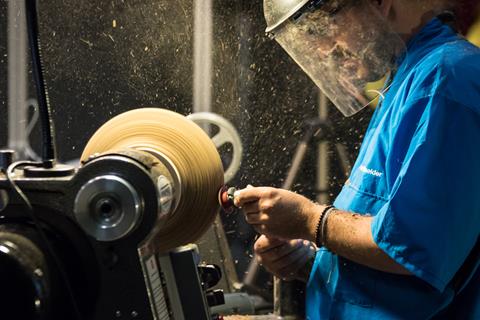
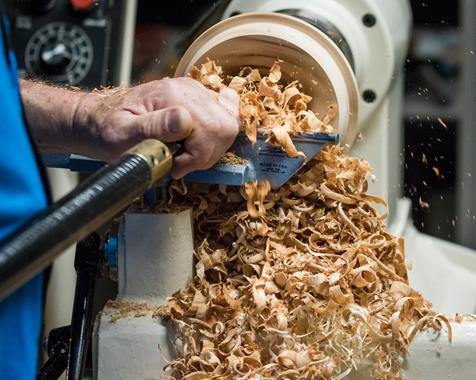
Unlike other machines in a shop, the lathe moves the wood, spinning it around. As the wood spins, a woodturner holds a sharp tool, which rests on a toolrest. The turner advances the tool into the spinning wood to remove the unwanted mass. Shavings fly.
Wood mounted on a lathe can be worked freshly cut, which turners call green, or dry. Air-dried wood is generally preferable to the kiln-dried variety.
Which way the grain runs changes everything
There are two basic methods of turning, and the difference between them is simply which direction the wood grain runs relative to the lathe bed. That one choice decides how the wood is held, which tools are used, and what you can make.
Spindle turning
When the wood grain runs parallel to the lathe bed, the turnings are called spindle turnings. The wood is held between the drive center at one end and the tailstock at the other. Bowls can also be turned spindle-wise.
Spindle work covers a wide range of objects:
Around the house
Candlesticks, egg cups, knobs, lamps, rolling pins, cylindrical boxes
Small and handheld
Pens, thimbles, knitting needles, needle cases, chessmen, spinning tops, Christmas ornaments
Furniture and architecture
Legs, spindles, pegs, balusters, newel posts
Larger forms
Tool handles, baseball bats, and hollow forms such as burial urns
Face grain turning
Turnings made with the grain of the wood perpendicular to the lathe bed are known as face grain or sidegrain turnings. They include bowls, platters, and chair seats. To hold the wood this way, the turner either screws it to a faceplate or grips it in a mechanical chuck.
A hollow vessel can be mounted either way — between centers as for spindle turning, or on a faceplate or in a chuck.
The words sound harder than the job
Live centers go with the tailstock, drive centers go into the headstock, faceplates and chucks thread onto the drive spindle. Lathe terminology can be various and confusing.
But the basic process stays straightforward: attach a piece of wood to a lathe so it can rotate, apply a sharp tool to the whirling wood, and make shavings until what is left has taken the form the turner set out to create.
If a word stops you, the glossary has it.
Woodturning 101
The beginner path