Kit contents
Whether you buy the starter kit or an individual kit, you’ll receive a fan/chip holder, a magnetic vent attachment, and two sealed foil scent chip packs for each air freshener. One scent pack is called “Ocean.” The second chip arrives unscented, allowing you to use a scented oil of your own choice (not available from the kit supplier; try your local health food store or search online). I gave the Ocean scent a sniff test and pronounced it agreeable, so I did not hunt around for anything in which to soak the unscented chip.
Prep blanks
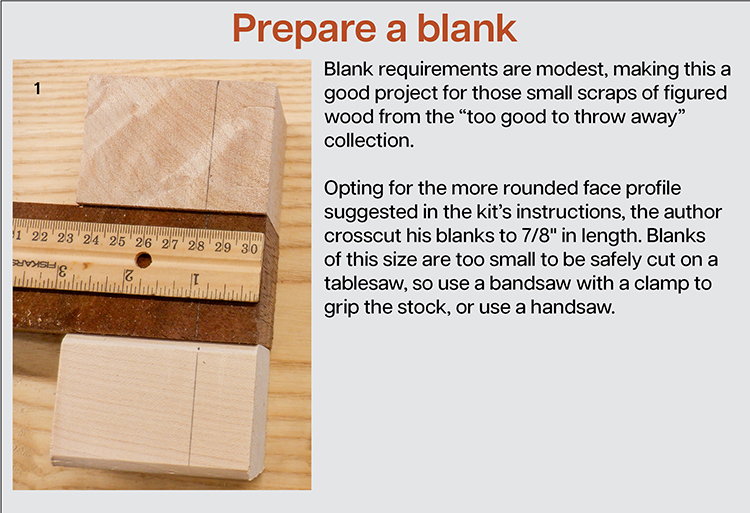
After perusing the two pages of instructions, which contained a surprisingly large amount of text with easy-to-understand photos and diagrams, I set about preparing three blanks for the kits. Because of the small size (at least 3/4" (19mm) in length and 1-1/2" (38mm) square), I easily found several options in the “small pieces I don’t want to throw away” section of my wood hoard. I selected blanks of hard maple, walnut, and figured soft maple. The directions call for crosscutting the blanks to 3/4", but the directions noted a wider blank will allow a more rounded profile. I took the advice and added an extra 1/8" (3mm) to the length of each blank (Photo 1).
Drill the blanks
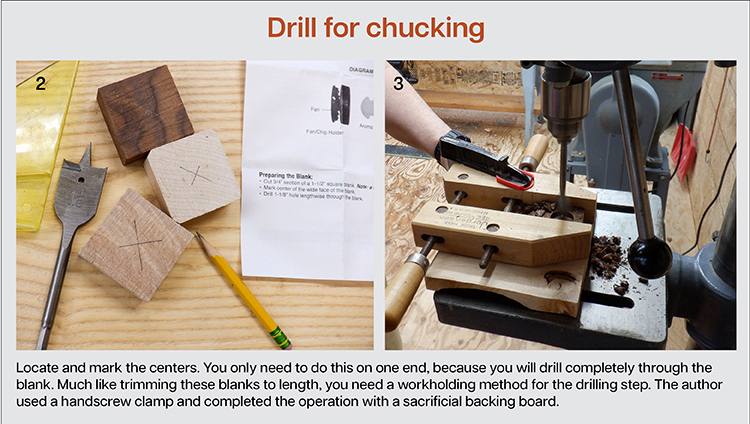
After I cut the blank to length on the bandsaw, I located the end centers for drilling (Photo 2). I chucked the spade bit in my drill press and secured each blank in a handscrew clamp affixed to the drill press table with a clamp (Photo 3). I used the kit’s spade bit for two of the blanks before noticing a bit of tearout, so I switched to a Forstner-style bit, which produced a much cleaner cut.
Mount a blank
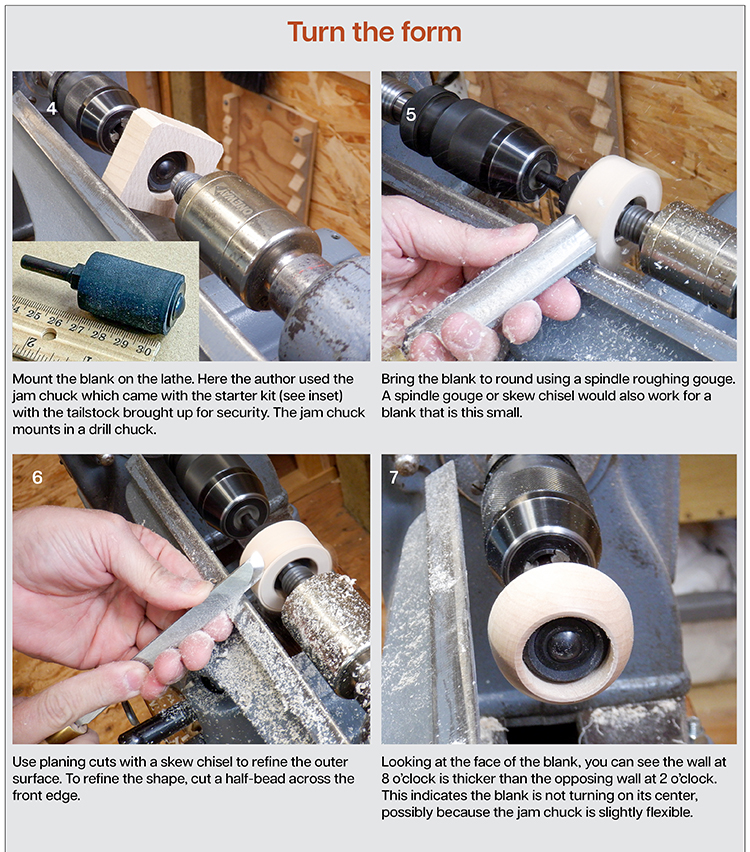
I decided to try the kit’s rubber jam chuck for the first turning. The chuck mounts in a drill chuck via its integrated mandrel. Mounting the blank square while simultaneously operating the mechanics of the chuck turned out to be a finicky operation. By rotating a nut on the rear of the chuck, the rubber cylinder expands to fill the drilled hole, but you must make sure the face of the blank is perpendicular to the axis of rotation and protruding from the chuck (Photo 4). Also, because my drill chuck tends to self-loosen during a turning session, I chose to bring up the tailstock for support.
Shape the blank
With the blank square and secure in the chuck, the fun (aka, turning) could start. I brought the blank to round with a spindle roughing gouge; this part went quickly and easily (Photo 5). I refined the surface with a skew chisel before shaping the front into a half-bead (Photo 6). After stopping the lathe, I noticed a problem of eccentricity, which is evident in the slight ellipsoidal shape around the drilled hole (Photo 7). I concluded that the rubber chuck flexed slightly during turning, causing the out-of-roundness.
I applied a minuscule amount of walnut oil for a finish and removed the turning from the chuck.
Applying lessons learned
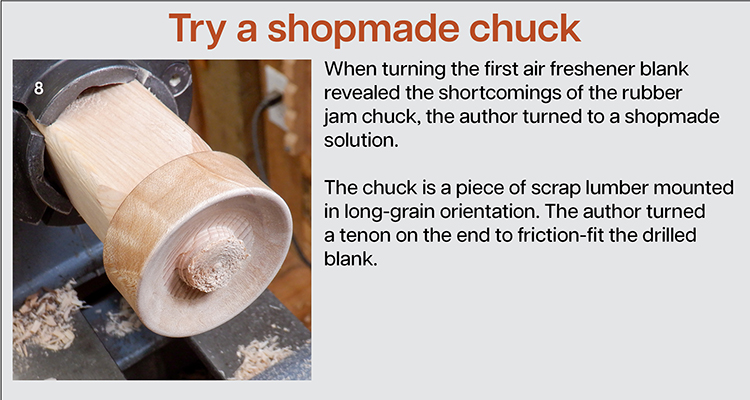
For the next two blanks, I ditched the rubber jam chuck in favor of a shopmade option. I mounted a piece of 2"- (5cm-) square scrap in my four-jaw chuck and turned a tenon on the end of the blank to friction-fit the drilled hole. This allowed for some additional design opportunities as I could cut into the sacrificial tenon (Photo 8).
Assemble the components
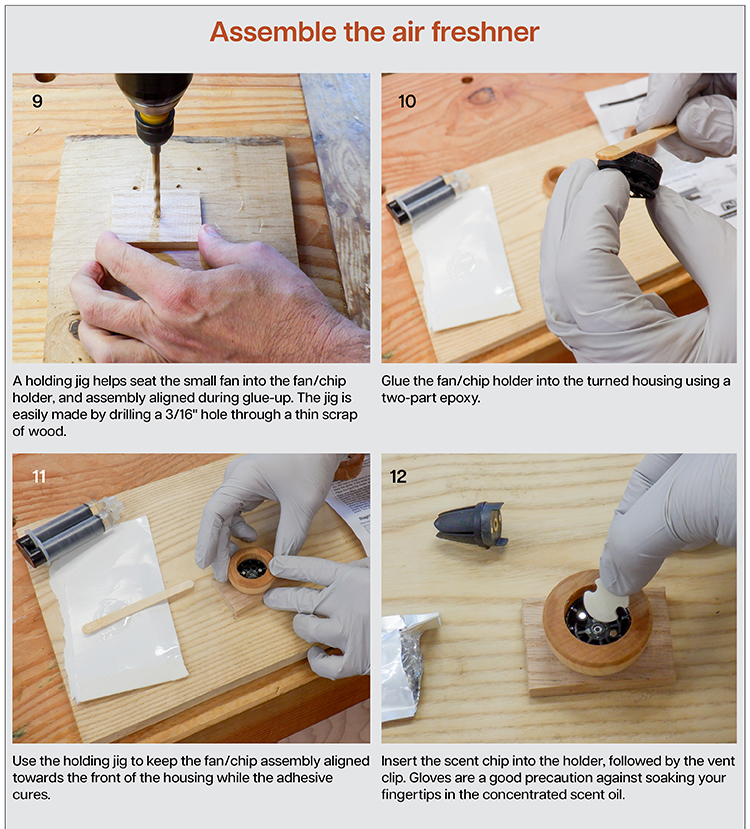
The directions stated that a “parts holding jig” would be necessary to seat the rounded center tip of the small fan into the fan/chip holder and then into the blank. I located a scrap piece of flat wood wider than the blank and drilled a 3/16" (5mm) hole through it (Photo 9). The jig allowed the fan/chip holder to sit squarely in what I found to be a slightly oversized hole.
I applied epoxy to the sides of the fan/chip holder, as this seemed easier than trying to get just the right amount of adhesive inside of the blank (Photo 10). When I set the assembled air freshener on the parts holding jig, I was happy to see it worked as promised (Photo 11). I also discovered I had picked up 20-minute epoxy instead of the 5-minute type I normally use. When I picked one of the fresheners up after a few minutes, the fan/chip holder started to slide out of the turned housing. Putting it back on the jig solved the problem.
I didn’t care to touch the scent chip with my bare hands, so I gloved up and placed the chip into the recess of the holder where it popped into place (Photo 12). The magnetic vent attachment clicked firmly onto the two attracting magnets in the fan/chip holder, completing the kit (Photo 13).
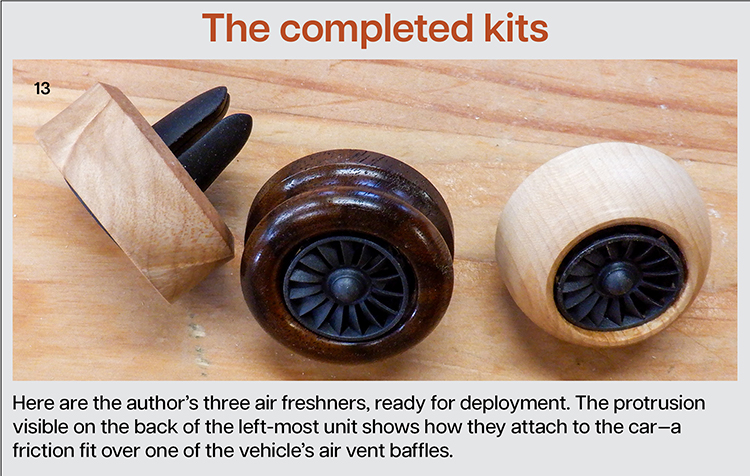
A short time later, the air freshener kits were stuck into the air vents of my car. A word of warning though: one air freshener is plenty for one car!
About the Author:
Rick Rich is a woodturner from Washington State. He is a member of the American Association of Woodturners (AAW), the Cascade Woodturners Association in Portland, Oregon and a founding member of the Southwest Washington Woodturners in Vancouver, Washington.